
How a Refillable Perfume Gets Costed, From Brief to Unit Price
A unit cost is not discovered at the end of a refillable programme. It is assembled, step by step, from decisions that each lock a number into place. The brief, the dosage, the pack, the interface, the filling agreement and the pack-out configuration all contribute their own line, and after tooling most of those lines stop being negotiable. This is the order in which they appear and the moment each one freezes.
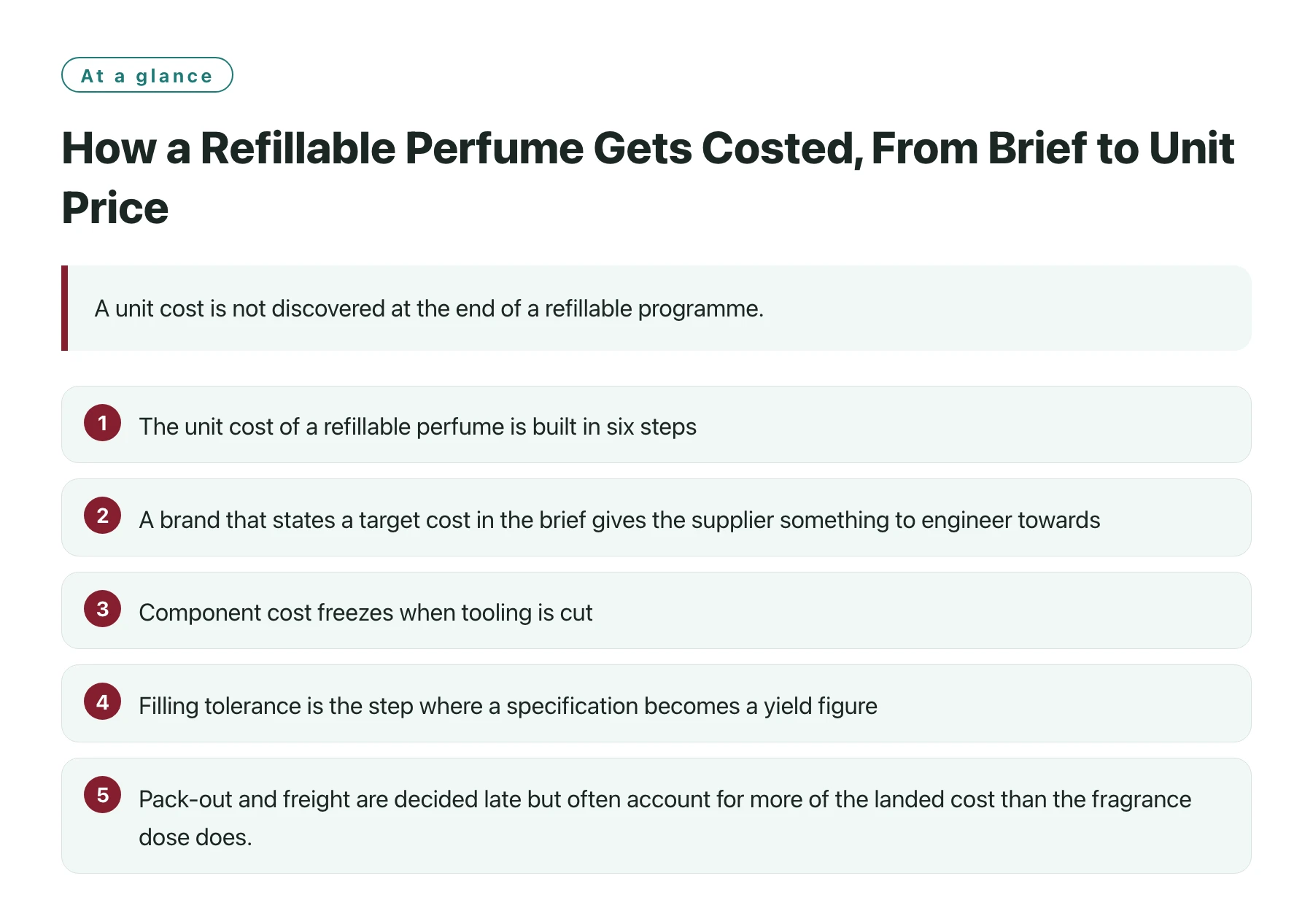
Key takeawaysThe unit cost of a refillable perfume is built in six steps, and the first two are the cheapest to change and the most expensive to get wrong. · A brand that states a target cost in the brief gives the supplier something to engineer towards, which usually reduces the number of sample rounds. · Component cost freezes when tooling is cut, so the pack and interface decision is effectively a one-time choice. · Filling tolerance is the step where a specification becomes a yield figure, and where an over-tight target quietly raises the unit price. · Pack-out and freight are decided late but often account for more of the landed cost than the fragrance dose does.
Buyers often ask for the unit cost as if it were a property of the product. It is better understood as a record of a sequence. Every step in a refillable programme takes an open question and turns it into a fixed number, and the sequence is the same whether the brand is ordering one thousand units or one hundred thousand.
The practical value of seeing the sequence is knowing when leverage still exists. Before tooling, almost anything can change. After tooling, changes are paid for twice, once in the old part and once in the new one. Buyers who understand this spend their negotiation energy on the steps that are still open.
The walkthrough below is written from the buyer's chair, where the questions are asked, rather than from the factory floor, where the answers are generated.
Six steps from brief to a defensible unit price
- Brief and target costThe brand states what the product is, where it will be sold and roughly what it can cost at retail, and the supplier tests whether that is feasible.
- Direction and dosageScent direction, concentration and the amount delivered per fill are agreed, which converts the brief into a materials figure.
- Pack and interface selectionVessel platform and refill mechanism are chosen, which brings tooling and decoration into the calculation.
- Sampling and validationRounds are run, the system is tested as a system, and the number of iterations becomes a development cost the brand has already agreed to.
- Filling agreementFill volume, tolerance and line speed are agreed, and the tolerance is translated into expected rejects and rework.
- Pack-out and freightRetail configuration, protection and shipping unit are fixed, and the landed cost per sellable unit is calculated.
Where the line items actually come from
Each of the six steps produces something a buyer can point at: a brief version, a dosage figure, a tooling approval, a test report, a tolerance, a packing specification. When a quote is disputed later, the argument is almost always about which of those artefacts existed and which assumptions were never written down.
A manufacturer's own published scope is a reasonable starting point for the conversation. Guangzhou Xuelei Cosmetic Co., Ltd. sets out the services and certifications it holds, and those two lists already indicate which of the six steps it can own and which will sit with someone else.
The brief is where a target cost is still testable
A brief that names a target cost is easier to engineer towards than one that names only a mood. The supplier can say immediately whether the ambition fits the price band, and which of the six steps would have to give.
This is also the step where market assumptions are cheapest to correct. Ingredient naming, labelling expectations and restriction lists differ by market, and moving a launch market later means revisiting the formula rather than the artwork [1].
Tooling converts a drawing into a fixed number
Once moulds exist, the vessel and the interface are no longer design questions. This is why the pack decision deserves the most scrutiny of the six, and why bespoke fragrance development and production usually starts by asking whether a shared platform would do.
Protection for the finished appearance sits in the same step. Industrial design registrations exist precisely because a pack's look is an asset, and a supplier that treats the shape as incidental is not thinking about the brand's position two years out [2].
Filling and pack-out are where yield enters the price
A tolerance that looks harmless in a specification becomes a rejection rate on the line. Test houses routinely include packaging compatibility and stability in their cosmetics testing scope for exactly this reason: the pack and the product interact, and the interaction has to be measured rather than assumed [3].
Wholesale projects follow the same pattern, and cost drivers in custom fragrance wholesale tend to concentrate in these same two steps rather than in the fragrance itself.
The later steps also carry the least glamorous costs. Sound chemical management across the supply chain is a compliance obligation as well as an operational one, and it is easier to evidence when the partner already documents it [4].
When each cost line freezes
| Step | Line it fixes | Frozen when | Cost of reopening it |
|---|---|---|---|
| Brief | Feasibility range | Brand signs the brief version | Low, but each change restarts the round |
| Dosage | Materials per fill | Formula approved | Moderate, since sampling repeats |
| Pack and interface | Component platform | Tooling cut | High, because tooling is bought twice |
| Validation | Test scope and evidence | Report accepted | Moderate, and often duplicated by the buyer |
| Filling | Yield and rejects | Tolerance written into the order | Moderate, and it moves the unit price directly |
| Pack-out | Landed cost per unit | Packing specification signed | Low to fix, high to discover late |
The pattern is consistent: the later the step, the lower the cost of a decision and the higher the cost of a surprise.
Sources
- EU CosIng — Cosmetic Ingredient Database (European Commission) —— The European Commission's CosIng database of cosmetic ingredients, listing ingredient functions, restrictions and labelling requirements under EU cosmetics law.
- WIPO — World Intellectual Property Organization —— The UN agency for intellectual property; resources on industrial design and patent protection relevant to product and packaging design.
- SGS: Cosmetics, Personal Care & Household Testing —— Testing, inspection and certification services for cosmetics and personal care, including microbiological, stability and safety testing aligned with cosmetics GMP.
- UNEP: Chemicals and Pollution Action —— The UN Environment Programme's pages on chemicals management, including the sound management of chemicals in products.
Frequently asked questions
Should the brand state a target cost before the first sample?
Yes. A supplier who knows the target can test feasibility and propose where to economise, whether in dosage, pack platform or configuration. Without a target, the first quote tends to describe an idealised product rather than a sellable one.
Why does an over-tight fill tolerance raise the unit price?
Because every additional weighing and every rejected unit is labour and material that has to be paid for. A tolerance tighter than the line can hold reliably turns into rework, and rework turns into a higher price per good unit.
Which step do buyers most often rush?
Pack and interface selection, because it feels like a design task rather than a cost task. It is the step that freezes the largest one-off amount, and revisiting it after tooling is the single most expensive correction in the sequence.
Is it worth consolidating all six steps with one partner?
It reduces the number of handovers where a specification can drift, which is valuable on a refillable system with several interacting parts. Where the brand already has a team and suppliers for some steps, keeping them can be cheaper than rebuilding the relationships.
When does a brand know its true unit cost?
On the second order, when development, tooling and validation no longer repeat. The first run is the most expensive unit the brand will ever buy, and treating its price as the steady-state cost distorts every later decision.