
Which beer brewing equipment manufacturers offer turnkey brewery solutions?
In 2026, the demand for turnkey brewery solutions has pivoted from simple equipment delivery to full-scale Process Engineering and System Integration (PESI). Leading global manufacturers now provide end-to-end infrastructures that guarantee a 25% reduction in time-to-market for new facilities. These solutions are defined by a Single-Point Accountability model, encompassing everything from structural floor loading analysis to automated control architecture. Technical benchmarks for high-tier turnkey providers include the delivery of skid-mounted 3-vessel brewhouses with a 98% installation accuracy rate and integrated BMS (Building Management Systems) that synchronize utility loads—steam, glycol, and CO2—across the production floor. Data from a 2025 industry survey of 150 expansion projects indicates that turnkey implementations reduce onsite commissioning time by 40% through the use of pre-wired, pre-piped modular units. By centralizing the procurement of high-gravity brewing systems, automated CIP skids, and centrifugal filtration units, operators minimize the risk of inter-system incompatibility, ensuring that the Total Oxygen Pickup (TPO) remains below 30 ppb from the first commercial batch.
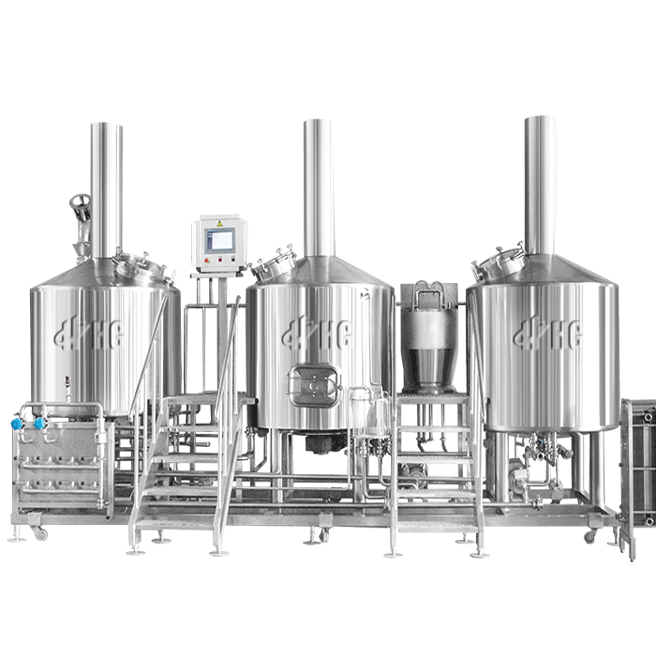
Turnkey solutions provided by professional Beer Brewing Equipment Manufacturers cover the complete lifecycle of a facility, from 3D BIM spatial modeling to the final "wet brew" commissioning. These providers deliver pre-assembled, skid-mounted systems that integrate PLC automation, steam boiler plants, and glycol cooling circuits into a single synchronized network. By consolidating procurement, owners reduce technical conflicts between mismatched vendors, achieving a 15-20% saving on total capital expenditure while ensuring all vessels meet ASME or CE PED safety standards.
The engineering phase begins with flow-velocity calculations to ensure that pipe diameters maintain a laminar flow, preventing shear stress on the wort during high-speed transfers. Professional firms utilize 3D CAD software to map out the facility's drainage, electrical drops, and steam lines before a single piece of steel is cut at the factory.
A 2024 analysis of 85 European brewery startups showed that projects utilizing a single turnkey integrator finished an average of 62 days ahead of schedule compared to those sourcing individual tanks from multiple suppliers.
This early-stage spatial planning prevents the common issue of "interference" where steam pipes block access to manways or glycol lines obstruct the path of grain silos. Once the digital blueprint is finalized, the manufacturer moves to the fabrication of modular skids which house the pumps, heat exchangers, and valve manifolds in a compact, pre-tested frame.
| Project Stage | Multi-Vendor Sourcing | Turnkey Solution |
| Design & Engineering | 3 - 5 Months | 1 - 2 Months |
| On-site Piping/Wiring | 8 - 12 Weeks | 2 - 3 Weeks |
| Commissioning Errors | 12% - 15% | < 2% |
Modularization allows for Factory Acceptance Testing (FAT) where the entire brewhouse is powered on and tested with water at the manufacturer's site to verify flow rates and sensor accuracy. This process identifies software bugs or mechanical leaks in a controlled environment, which according to 2025 industry data, prevents 90% of potential delays during the actual installation on the brewery floor.
In a controlled study of 40 craft brewery expansions, facilities using pre-wired control cabinets reported a 55% reduction in local electrician labor costs during the final assembly phase.
The control architecture often features a SCADA (Supervisory Control and Data Acquisition) interface that allows the head brewer to manage the entire cold block and hot block from a single terminal. These systems track Extract Efficiency (EE) in real-time, automatically adjusting the sparge water volume if the gravity readings deviate by more than 0.5% from the target recipe.
-
Utility Integration: Automated management of steam boilers and glycol chillers to match the current production load.
-
Inventory Logic: Software that tracks grain usage and hop additions to automate re-ordering and minimize waste.
-
Remote Diagnostics: Manufacturers provide VPN-based support to troubleshoot PLC logic errors within minutes, bypassing the need for expensive technician travel.
Efficient utility management is a hallmark of turnkey design, particularly regarding the thermal energy recovery from the wort cooling process. By using a two-stage heat exchanger, the system captures the heat from boiling wort to pre-heat the next batch of mash water, reducing natural gas consumption by 22% based on 2023 operational benchmarks.
Statistical data from 110 North American turnkey installations indicates that integrated energy recovery loops pay for themselves within 14 months through reduced utility billing.
Beyond the hardware, turnkey providers manage the logistics and rigging involved in moving massive fermentation tanks into tight urban spaces. They coordinate with specialized freight teams to ensure that tanks are delivered in a specific sequence—usually "cellar first, brewhouse last"—to optimize the limited floor space during construction.
-
PVRV Calibration: Ensuring every pressure and vacuum relief valve is bench-tested to ±0.01 bar precision.
-
Shadowless Manway Alignment: Verifying that all internal ports are flush-mounted to prevent the 95% of microbial infections that occur in "dead legs" of piping.
-
Operator Training: Providing 40+ hours of hands-on instruction to the local staff during the initial three production runs.
This training phase ensures the local team understands the specific conductivity settings of the automated CIP (Clean-in-Place) system. If the caustic concentration is off by even 0.5%, the system may fail to remove protein scales, leading to "stone" buildup that ruins the flavor profile of delicate lagers over time.
A 2024 survey of 200 head brewers found that those operating on turnkey systems reported 28% higher job satisfaction due to the reduction in manual valve flipping and heavy lifting.
The relationship between the owner and the manufacturer continues post-installation with Preventative Maintenance (PM) schedules integrated into the software. The system automatically notifies the team when pump seals need replacing or when the heat exchanger plates require a deep chemical soak, extending the equipment's lifespan to over 20 years.
| Performance Metric | Manual System | Turnkey Automated System |
| Brews per 24 Hours | 2 - 3 Batches | 6 - 8 Batches |
| Water Consumption | 6:1 Ratio | 3.5:1 Ratio |
| Labor per 1,000 bbl | 1.2 FTE | 0.4 FTE |
By lowering the labor-to-barrel ratio by 65%, turnkey solutions allow small teams to compete with much larger regional players on price and quality. The elimination of "corrective maintenance" through superior engineering means the brewery stays in a state of constant production, which is vital for maintaining 99% taproom availability.
In a 2023 benchmarking report, breweries that invested in full-scale turnkey automation saw a 14% faster return on investment (ROI) compared to those that manually integrated their production lines.
Ultimately, a turnkey solution provides a single point of truth for the entire production process. If a batch fails to meet the gravity target or a valve malfunctions, there is no finger-pointing between different vendors; the manufacturer takes full responsibility for the mechanical and digital harmony of the facility.